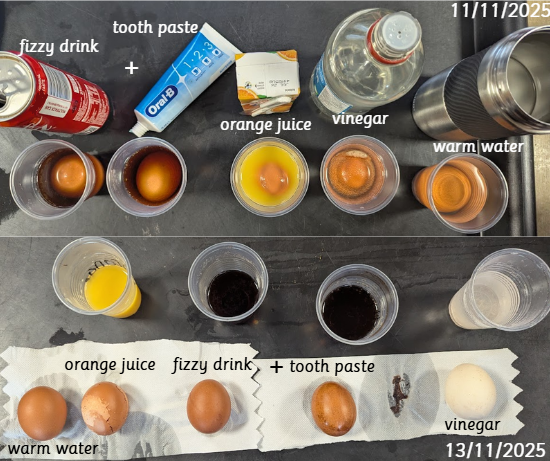
During Science Week, in conjunction with Ms Cawley's First class, the children carried out a two-day investigation to learn about tooth enamel and how different drinks can affect our teeth. We discussed how tooth enamel protects our teeth, much like a protective jacket. Since eggshells are also made of calcium, they provide a useful model for exploring how acids can affect enamel.
We placed boiled eggs into different liquids:
-
🥤 Fizzy drink
-
🦷 Fizzy drink with toothpaste
-
🍊 Orange juice
-
🍶 Vinegar
-
💧 Warm water (our control)
Over the two days, the children made predictions, observations, and comparisons.
The vinegar cup showed the most dramatic change. The shell began bubbling quickly and became soft and easier to peel, helping the children see how acid can break down calcium.
In the fizzy drink and orange juice cups, the children observed staining, small cracks, and softening, which helped us discuss how acidic drinks can weaken tooth enamel.
The toothpaste cup demonstrated how toothpaste can help protect and clean teeth, although we also discussed that brushing cannot completely reverse damage.
The warm water cup showed very little change, helping the children understand why water is the safest drink for our teeth.
Throughout the investigation, we discussed:
-
How acids affect tooth enamel
-
The importance of brushing and using toothpaste
-
Healthy food and drink choices
-
Food safety, including why we cannot eat the eggs after the experiment
The children asked thoughtful questions and enjoyed observing the changes each day, making this a memorable way to connect science, health education, and real-life learning about caring for our teeth. 🧪🦷🌟
🎥 Slow-Motion Science!
To extend our investigation, we used technology to record the vinegar egg bouncing in slow motion. The children were fascinated to watch the movement closely and see how the egg bounced after its shell had dissolved.
We discussed why this happens — the vinegar removes the hard shell, leaving behind a soft, rubbery membrane that allows the egg to bend and bounce instead of cracking.
This was a wonderful opportunity to combine Science and Technology, allowing the children to observe the results of the experiment in a new way and reflect on their scientific learning. 🌟
P. S. If you listen carefully to the video, you might hear some very slow, very loud “woooowww!” sounds in the background — don’t worry, those are not cows… just our scientists reacting in slow motion! 🐄😄


