This week, the children became young scientists as we explored the fascinating life cycle of a frog through a range of hands-on investigations, discussions, and creative activities.
We began our learning by completing a KWL chart (What we Know, Want to Know, and Learned). The children asked thoughtful higher-order questions about frogs, their habitats, and how they grow and change. These questions helped guide our learning throughout the week. To support their curiosity, we explored the answers together through discussion and a storybook created especially for the class, which the children thoroughly enjoyed.
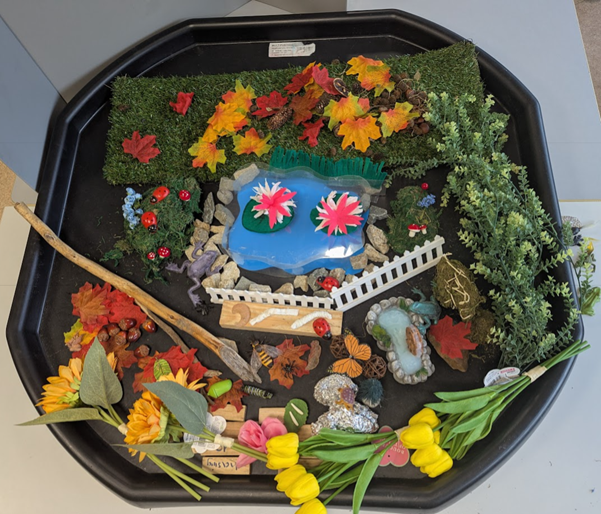
To deepen our understanding, we created a pond habitat using a tuff tray where the children could explore and investigate. The tray included a raised pond, rocks, plants, lily pads, and natural materials, helping the children imagine what a real pond environment might look like.
Some of our favourite investigations included:
🌱 Frogspawn Investigation
Chia seeds were soaked in water over the weekend and then placed into a bag to resemble frogspawn. This helped the children visualise what frog eggs look like in water and understand the first stage of the frog’s life cycle.
🐝 Wiggling Worm Experiment
The children added water to “worms” made from coiled paper. As the water was absorbed, the paper expanded, began to wiggle, and even changed colour slightly, leading to lots of excited “wow” moments as the children observed the changes.
✂️ Life Cycle Craft
The children created their own frog life cycle models, carefully cutting and arranging the stages from frogspawn to tadpole, froglet, and adult frog.
📚 Investigation Table
We also created a science investigation station where children could explore the topic further by:
-
Reading books about frogs and amphibians
-
Looking at real-life images of the different stages of the frog life cycle
-
Exploring insects and bugs that frogs eat
-
Learning more about pond habitats and ecosystems
🌍 Connecting to Our Local Environment
We discussed where frogs might live in our local natural environment, such as nearby parks and ponds. This helped link our learning to Geography and Nature Study, encouraging the children to think about wildlife that may live close to home.
The children also discovered that the Common Frog is the species found in Ireland. We compared this with other frogs from around the world, including:
-
🌳 Tree Frogs
-
🐸 Bullfrogs
-
🌍 Goliath Frogs – the largest frogs in the world
Through this project, the children developed many important skills, including:
-
Scientific curiosity and questioning
-
Observation and investigation skills
-
Understanding animal life cycles and habitats
-
Making connections between Science, Geography, and Art
-
Developing topic-specific vocabulary and discussion skills
The children were incredibly engaged throughout the project and loved exploring the pond habitat, carrying out experiments, and discovering more about the amazing life cycle of frogs. 🐸🌿💧


